Skip to content
You pull into the garage after a long summer drive, park in the same spot as always, and everything looks normal. Hours later, the tires cool. The next time the car moves, a patch of coating comes up with them.
That failure is commonly called hot tire pickup. It is one of the clearest differences between a thin garage paint and a properly prepared professional coating system. Tire heat matters, but heat is only part of the story. Adhesion, coating thickness, concrete preparation, tire chemistry, and cure quality all influence whether the floor stays bonded or starts lifting beneath the wheels. For Connecticut garages, July heat can expose weaknesses that were already built into the floor months earlier.
What Is Hot Tire Pickup?
Hot tire pickup happens when a vehicle tire bonds strongly enough to the floor coating that the coating separates from the concrete when the car moves.
The failure often appears directly beneath the tire contact patches.
You may see rectangular or curved peeled areas where the vehicle normally sits. Sometimes only the coating comes off. In worse cases, several layers separate together.
This is different from an ordinary tire mark on an epoxy floor.
A dark rubber mark is mainly a cleaning problem. Hot tire pickup is an adhesion failure.
If the coating is physically lifting from the slab, scrubbing harder will not solve it.
Tires Get Hotter Than Most Garage Floors Ever Do
Vehicle tires flex continuously while driving.
That flexing creates heat. Road temperature, speed, braking, distance traveled, tire pressure, vehicle weight, and summer weather can all influence tire temperature.
A car arriving home after a highway drive in July may place significantly warmer rubber onto the garage floor than a vehicle moved only a few blocks.
The tire then sits in one position while cooling.
If the floor coating is weak, soft, poorly bonded, or insufficiently cured, that repeated heating and cooling cycle can expose the problem.
The tire is not necessarily destroying a good coating. It is often revealing a coating that never had enough resistance or adhesion in the first place.
Tire Chemistry Matters Too
Heat is only one reason tires can interact aggressively with coatings.
Rubber tires contain various compounds used to control flexibility, durability, processing, and performance. Certain ingredients can migrate toward the tire surface, particularly under heat.
When warm tires remain parked on a coating for hours, the combination of pressure, temperature, and chemical contact can challenge weaker finishes.
This is one reason garage paint tire failure can occur even when the floor looked perfectly acceptable for weeks after installation.
A decorative paint film can survive foot traffic and still be poorly suited for repeated tire contact.
Why Thin Garage Paint Is Especially Vulnerable
A thin coating has very little material between the tire and concrete.
Many inexpensive garage paints are primarily designed to improve appearance, not build a high-performance flooring system.
They may be rolled directly over minimally prepared concrete. Some installations rely on acid cleaning, pressure washing, or simple degreasing rather than aggressive mechanical preparation.
The result can look impressive at first.
Then the floor enters real service.
Hot tires repeatedly press against the same four areas. Dirt and moisture arrive with the vehicle. Seasonal temperature changes affect the slab. Small weaknesses in adhesion become increasingly important.
Eventually, the coating releases.
This is why thin-film tire damage frequently appears in parking zones before the rest of the floor looks worn.
Hot Tire Pickup Usually Starts Beneath the Coating
When a coating peels under a tire, people often blame the top layer.
The more important question is where the failure occurred.
If the coating separated cleanly from smooth concrete, the problem may be poor surface preparation.
If an old paint layer remained underneath, the new system may have bonded to a weak existing coating instead of directly to sound concrete.
If concrete dust or contamination remained on the slab, adhesion may have been compromised before installation even began.
A professional diagnosis looks at the failure interface, not just the peeled section.
Understanding what let go helps determine whether the problem is local or whether the entire floor may eventually fail.
Smooth Concrete Is a Bad Foundation for Many Coatings
Fresh-looking concrete can actually be difficult to coat if the surface is too dense or smooth.
Coatings need suitable adhesion to the slab.
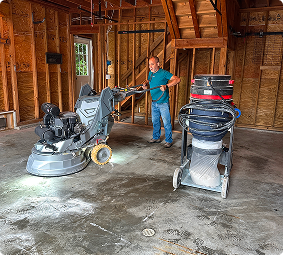
Professional mechanical preparation, commonly diamond grinding, removes weak surface material and creates a controlled profile for the coating to bond into.
Simply making concrete look clean is not the same thing as preparing it properly.
A floor can be spotless and still be poorly profiled.
When a coating is installed over smooth concrete, the tire may eventually have a stronger grip on the coating than the coating has on the slab.
That is when lifting begins.
Old Paint Creates Another Weak Link
Applying a strong coating over weak paint does not make the old paint stronger.
If an existing garage floor has paint that is peeling, chalking, poorly bonded, or unknown, coating directly over it can trap the same failure underneath the new system.
The new material may adhere well to the old finish.
Then the old finish separates from the concrete.
From the homeowner’s perspective, the new coating failed.
Technically, the weakest layer in the system failed.
This is why previous coatings should be evaluated and usually removed where necessary before installing a more durable garage floor.
Oil and Tire Residue Can Interfere With Adhesion
Parking areas are often the most contaminated part of an older garage.
Small oil drips, road grime, tire residue, cleaners, silicone products, and years of vehicle use can affect the concrete.
Some contamination sits visibly on the surface.
Other material penetrates porous concrete.
Mechanical preparation helps expose cleaner substrate, but heavily contaminated floors may require additional treatment.
Ignoring these areas is especially risky because they are also exactly where hot tires will apply repeated pressure after the floor is finished.
A Strong Topcoat Cannot Rescue a Weak Base
Homeowners sometimes focus heavily on the advertised strength of the clear topcoat.
That is only one layer.
A garage system works as a stack. The bond between concrete and base coat is just as important as the wear resistance of the surface above it.
A very tough topcoat installed over a weakly bonded base layer can still peel off as an intact sheet.
For hot tire resistant coating in CT, the whole system needs to work together: concrete preparation, repair materials, base coat, decorative layer if used, topcoat, and sufficient cure.
There is no single magic layer that compensates for shortcuts underneath.
Cure Time Is Part of Hot Tire Resistance
A newly coated floor can look finished before it has reached its intended performance level.
Coatings harden in stages.
Light foot traffic may be permitted relatively quickly, while vehicle traffic may require a longer wait.
Bringing a car onto the floor early places heat, weight, tire chemistry, and concentrated pressure onto material that may still be developing its final properties.
This is one reason installers give separate timelines for walking and parking.
Those instructions are not arbitrary.
If the manufacturer or installer specifies a vehicle return time, waiting the full period protects the coating during a particularly vulnerable phase.
July Is Often When Weak Floors Reveal Themselves
Connecticut is not known for year-round extreme heat, but summer garage conditions can still be demanding.
A vehicle driven on hot pavement may enter an enclosed garage carrying significant tire heat. The garage itself may already be warm, especially when afternoon sun hits the door.
Repeated parking in identical spots concentrates the stress.
A low-cost coating installed during cooler weather may therefore appear successful for months before its first serious summer test.
Hot weather does not always create the defect.
Sometimes it simply makes an existing adhesion weakness impossible to ignore.
Tire Marks and Tire Pickup Are Not the Same Problem
These terms are frequently confused.
A tire mark on an epoxy floor is typically surface discoloration caused by rubber or transferred material. Depending on the coating and contaminant, it may respond to suitable cleaning.
Hot tire pickup involves physical separation.
One problem changes the appearance of the coating.
The other removes it.
Before choosing a repair method, determine which problem you actually have.
Aggressive cleaning on an already delaminating coating may simply enlarge the damaged area.
Can Hot Tire Pickup Be Patched?
Sometimes.
If the failure is genuinely isolated and the surrounding coating remains strongly bonded, the damaged section may be mechanically prepared and repaired.
The challenge is determining whether the visible peeled spot is the whole problem.
If the same poor preparation exists across the entire garage, fixing four tire-sized areas may only delay the next failure.
Professional evaluation can involve inspecting surrounding adhesion and determining what remains beneath the failed coating.
Localized repair makes sense when the problem is localized.
Widespread adhesion problems usually require a more comprehensive solution.
The Cheap Coating Problem Is Often a Cheap Preparation Problem
People frequently compare garage coating prices by square foot without asking what happens before the first layer is applied.
That can be misleading.
Two companies may both advertise an attractive finished floor, yet one price includes extensive diamond grinding, edge preparation, crack repairs, old coating removal, vacuuming, and a multi-layer system.
The cheaper quote may depend on lighter preparation and thinner materials.
At installation, both floors can photograph well.
Months or years later, the difference becomes easier to see.
Concrete coating performance is heavily influenced by work that disappears completely once the finished floor is installed.
More Coating Is Not Automatically Better
Thickness matters, but blindly applying more material is not the answer.
Each coating system has intended coverage rates and application requirements.
Applying too little can reduce performance.
Applying too much can create its own curing or application problems.
The objective is a properly engineered system applied at the correct thickness over correctly prepared concrete.
Hot tire resistance comes from the complete installation process, not simply pouring extra product onto the floor.
What a Tire-Resistant Garage Floor Should Prioritize
A garage expected to hold daily-driven vehicles should be designed for actual automotive use.
The coating should tolerate repeated tire contact, road residue, cleaning, abrasion, and seasonal changes.
Equally important, the slab should be mechanically prepared so the base coat develops reliable adhesion.
For Connecticut homeowners, winter performance also matters. The same parking spots that face hot tires in July may see melted snow, road salt, sand, and cold moisture in January.
A good garage system has to survive both.
Why DIY Floors Often Fail First Under the Tires
DIY kits can fail in many locations, but tire paths tend to reveal weakness quickly.
Homeowners may spend considerable effort washing and etching a garage without realizing that the remaining concrete surface still does not provide the same profile as mechanical grinding.
Mixing errors can also matter.
So can coating too large an area after the product has begun reacting in the bucket.
Thin application, incomplete coverage, contamination, and premature vehicle return further increase the risk.
The project may look successful immediately after installation because none of those weaknesses are obvious visually.
Then regular vehicle use begins.
A Professional Floor Should Be Designed Around Parking, Not Photography
The true test of a garage floor is not how it looks the afternoon it is finished.
It is what happens after hundreds of parking cycles.
Cars arrive wet.
Tires arrive hot.
Salt gets tracked inside.
Tools fall.
Vehicles leak occasionally.
Floors get cleaned.
Temperatures change.
A coating system designed for those realities has a better chance of retaining both its appearance and bond.
If a garage coating only performs under showroom conditions, it is not much use in a working Connecticut garage.
Preventing Hot Tire Pickup Starts Before the Coating Is Opened
Once the coating is being rolled, many of the most important decisions have already been made.
The slab has either been prepared properly, or it has not.
Contamination has either been addressed or ignored.
Weak previous material has either been removed or buried.
Cracks and repairs have either been evaluated or rushed past.
A hot tire resistant coating in Connecticut begins with those less glamorous steps.
For Epoxymize, a durable garage floor is not just about choosing a tougher coating chemistry. The system has to be matched to the concrete and installed with the expectation that vehicles will actually be parked on it through hot summers and messy winters.
Frequently Asked Questions About Hot Tire Pickup
Why does garage floor coating peel only under my tires?
Tire areas experience concentrated weight, heat, rubber contact, and repeated parking in the same locations. If adhesion between the coating and concrete is weak, those stresses can expose the problem before failure appears elsewhere on the floor.
Can hot tires damage a properly installed epoxy floor?
A professional coating system designed for vehicle traffic should be far more resistant to hot tire pickup than thin garage paint. Performance still depends on proper concrete preparation, compatible materials, correct application, and allowing the coating to cure before vehicles return.
Are black tire marks a sign that my epoxy is failing?
Not necessarily. Tire marks can be surface transfer or staining without any loss of adhesion. If the coating remains firmly bonded, the problem may only require appropriate cleaning. If the coating material is physically lifting or sticking to the tire, it is a different and more serious issue.
Why did my garage paint survive winter but peel in summer?
Summer driving can increase tire temperature, and warmer garage conditions can put more stress on a weak coating. If preparation or adhesion was marginal from the start, the first period of sustained hot tire contact may reveal the weakness even though the floor survived cooler months.
Can I put a stronger clear coat over peeling garage paint?
Usually, coating over material that is already losing adhesion does not solve the underlying problem. The new layer may simply peel away with the weak coating beneath it. Failed material should be evaluated and removed as necessary before installing a new system.
How long should I wait before parking on a newly coated garage floor?
Vehicle return times vary by coating chemistry, temperature, humidity, and the specific system installed. Follow the installer or manufacturer’s stated cure schedule rather than assuming the floor is ready because it feels dry or can already handle foot traffic.